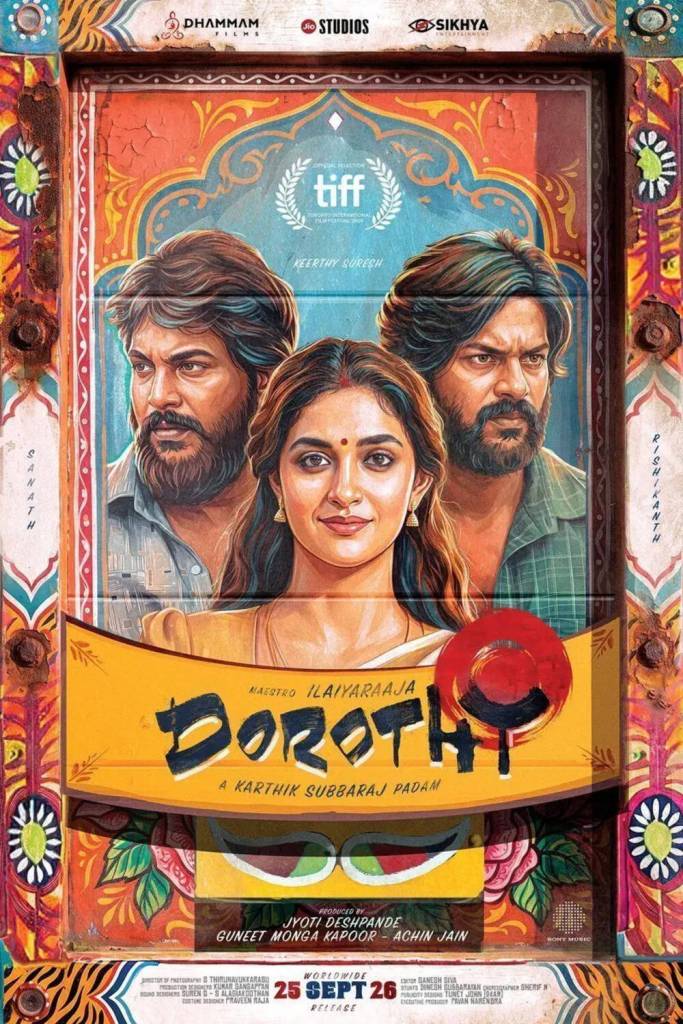
There are very few films that I go to without looking at any reviews. Karthik Subbaraj’s (KS) films are one of them. With Dorothy, he has proved again that I can continue to have that faith in him.
Some spoilers ahead definitely!
KS deals with a very complex subject of gender identity in Dorothy and what I loved a lot about this film is how true KS has stuck to what he wanted to make without any compromises.
This is one of the recent bold attempts in Tamil cinema. And kudos to KS for exploring gender identity in such a depth.
KS goes deep into the male ego just like how he did in Iraivi. And he delivers it in raw, on your face fashion.
A french kiss comes a full circle.
A person who runs a small “Military Hotel” and probably hasn’t even killed an animal okays killing of a person. While a person who does his living for killing questions who is he to take a life of another person. This also shows how society has conditioned us that it’s ok to take someone’s life in the name of “honor”.
There is a close up shot towards the climax where the facial expression reveals why the movie is about “Dorothy” – its just beautifully done. Hats off to Sanath for pulling it off.
KS also uses lot of visual elements to convey his thoughts in the movie – something I haven’t seen in his earlier movies.
There is a beautiful shot at the top of the mountain where one person is shown purposefully taller than the other – I won’t reveal much about this shot. It has to be seen to feel why KS is an important, intelligent director in the current times.
Similarly there is a landscape shot where two characters are shown against a backdrop of huge mountainous rocks – showing how small we humans are when compared to nature.
The male ego
I loved how KS went into the depths of male ego in Iraivi. Unlike K.Balachandar (full respect for him as I say this) who typically stages from the women point of view (by having women protagonist like Sujatha and Revathy and Saritha), KS shows how bad the male ego is in our society through the male characters itself. As a man, when I see those characters, it fundamentally raises an internal question like “How bad we have been!”.
In Dorothy, there are many such examples very strongly established in the first half of the movie (more about the two halves of a KS movie in a bit).
The movie starts with a old man who heads a family whistling to “Manidhan enbavan dheivam aagalam” song. Only to be shown very quickly that he is the very definition of an animal within a man.
The “Karthi” character who is shown to be “soft” during the childhood days, when becomes a man, doesn’t even give a damn when his girl gets married to another person – he simply calls her a “Pottachi”, drinks and dances in the wedding. A strong depiction of what a male dominated society can do to men.
The “Karthi” character itself is not able to accept his very own close friend (who’s life he saves multiple times) as a trans.
The male dominated society shown through the lens of the three men in the family even decides to take down lives of their very own – in the name of honor. All the honor killings that we read in the news.
Take a simple act of eating a “Parota”. KS brilliantly shows a scene right in the childhood days of the two friends. A “man” is not supposed to eat a “Parota” by taking a piece of it and dipping it in the “Kurma”. But rather by tearing up all of the “Parota” and mixing the “Kurma”. That’s how a strong “man” eats it.
Speaking of Parota, there is a brilliant shot in the second half where the “Kurma” (salna) mixing with Parota is used to representing blood draining out. Just sheer KS brilliance.
While showing these side of the male ego, KS very intelligently brings the female perspective. Through a mother.
A mother calls out that it’s OK for men to cry.
And she is the one accepts “Subbu” when he becomes a woman.
A woman friend accepts “Subbu” for what he/she is.
Men don’t cry
Our society has always shaped men with this – “Aaambala nna azha koodadhu”.
KS deals with this brilliantly in this movie.
The “Subbu” character in the childhood keeps reminding his friend “Karthi” that men don’t cry. And when the movie transitions to their adult lives – it’s “Subbu” who sheds tears.
“Karthi”, like most men, begins to learn that to be man – you should not cry, bury those emotions and take actions (to the extent of deciding to killing his friend) because that’s what defines a man.
The “Karthi” character is not even able to cry out in the later part of the movie as he goes through an internal turmoil – torn between what he feels for his friend and what he is expected to do.
KS brilliantly brings out how men are brought up in our society. Though an average man today doesn’t go to the extent of killing people, they simply cry within. They cry within themselves, when everyone has slept and no one is around, within the walls of a bathroom, shed a tear when driving alone in a car. They are not allowed to cry out even when their loved ones leave the world – they are supposed to be strong. Crying is a sign of weakness.
The Two Halves of a KS movie
I have always viewed KS movies having two distinct halves. And the second half being completely different from the first half.
When you come back from the interval of any KS movie, the rest of the movie is something you don’t expect at all. And sometimes it doesn’t work – case in point is Retro.
But I felt, this is one of the movies where the shift isn’t such drastic when compared to his previous work.
The movie definitely shifts tracks but I felt it still stuck to the overall premise much better than his earlier movies.
Based on the events of the first half, one typically expects a violent revenge drama set in rural TamilNadu. But it completely takes off in a different way in the second half.
KS could have simply taken that revenge drama. It would have suited very well with the current trend in Tamil movies of taking bloody violent movies. The movie would have made a lot of money.
But that’s were KS has stood his ground and has made what we truly wanted to make. And that’s the reason why I always consider him one of the best.
Ilayaraja
There was a lot of hype for Ilayaraja. In fact it’s one of the other main reasons for me to have gone to the theatre without reading any reviews – how would KS and IR be on screen?
It’s hard for me to say this as an IR fan – but his presence in the movie wasn’t felt that much. Except when Do Anything from How to Name It was beautifully used.
It appears that KS wanted to use a few IR past background scores and songs and instead of getting into copyright challenges with him, he just got him as the music director in the movie and still used his old compositions. There is a song in the second half which even sounded like “Maanin Iru Kangal Konda Maanae Maanae” song.
Myshkin was able to get some of the best scores out of IR. But KS probably just settled for what we all grew up with.
There are just so many small small things about the movie that I loved. Some of them are typical KS things that he does in every movie.
A cleverly placed advertisement of Nayagan that also reinforces the timeline of the movie.
A shot that shows a poster of the movie “A view to Kill” where the man is viewing the actress’ thighs 🙂
The transition at the beginning of the movie from a scar in the head of Karthi to how he actually got the scar.
And of course, playing “Malarndhum Malaradha” song from “Paasa Malar” – I invariably expect this in every KS movie since he used it as his signature in Jigarthanda.
Overall it’s one of the finest work of KS – only next to Jigarthanda. That’s still his best work for me.
One last example: The character “Karthi” is shown as a scared boy in his childhood – he is being grown up by his mother and without a father. But he later ends up as a violent man. The character “Subbu” is shown as a strong boy unfraid of anything in his childhood – he grows up in a family without women amongst violent men. But he later ends up discovering himself as a woman. This just sums up KS for me.
I tell my movie buddy that KS is 2000’s Mani Ratnam. Of course, no one should be compared with others. But when it comes to writing, taking unconventional subjects, casting lesser known heroes and sticking to the subject – I always felt MR as the gold standard in Tamil cinema. I still get goosebumps just thinking about Mouna Ragam (there is a reference to the Kambili Poochi in Dorothy as well), Anjali – how could MR delve into those worlds?
KS is our current day version of MR.
KS: You are an important movie maker for Tamil cinema. An intelligent one. As they say “moola kaaran”. I will continue to watch your movies. For you.